Before the countdown: It is 8:30 a.m. at the airport in Jakarta, Indonesia. I arrive a bit blurry-eyed due to my 5:30 a.m. wake-up call, but I have a naïve spring in my step none-the-less.
Hour one: I have taken a $.50 bus ride to the train station in the city center. I spent most of the ride marveling at the overlapping free-ways, sparkling high rise buildings, fancy SUVs, international-class hotels and restaurants, and the man next to me who is typing on three black-berries simultaneously that make this city of 10 million feel more like New York than Indonesia.
Hour one point two-five: It is September 8th. It is 9:45 a.m. The next available train ticket to Yogyakarta, the city which is to be my final destination, is for September 10th at 8 p.m. Plan B.
Hour one point five: I am arguing with a man about whether a cab to the bus station should cost 70,000 rupiah or 50,000 rupiah. I realize I am actually arguing with a man about whether a cab to the bus station should cost $7 or $5. Screw it. I’ll settle on six and a half.
Hour two: I arrive at the bus station, sweaty, breathless, and with much less spring in my step, after risking my life to cross a major bus-filled highway on foot. I paid the man 65,000 rupiah to drive me here and he “cannot pull into the station, cabs not allowed.” I see a cab stop in front of the station. The couple that gets out is neither sweaty nor breathless. I should have paid him 70,000.
Hour two point five: I have managed to find the one person who speaks English in the crowd of thousands lining up to get on tens of buses. She leads me to a bus that she promises will take me to Yogyakarta. The bus is empty. She leaves. It is 11 a.m.
Hour two point seven-five: It is 11:15. I am alone on a bus, which I think is going to Yogyakarta, but I am not really sure. I have no ticket. There is no air-conditioning. I’m not sure if the bus even runs. I think I better find the English-speaking woman.
Hour four: The woman has sold me a ticket. The bus leaves at 2 p.m. In the meantime, I have eaten a box of chocolate-covered strawberry filled cookies and am working on my second course…something called cheese cookies and what looks like a juice box of tea. A very small, very happy graying Indonesian man is telling me that he is an English teacher at a local school and would like to practice conversation. We are standing amidst the exhaust fumes of thirty buses and are surrounded by crowds of sweaty people straining to hear bus numbers which are simply shouted out over the din by young boys in blue button-ups. No one except my bus mistress, my enthusiastic English-teaching friend, and I speak English. I am quite amused.
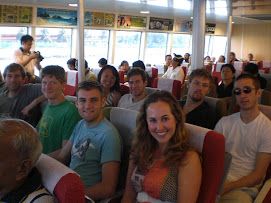
Hour five: It is 1:30 in the afternoon. I have boarded the bus. Everyone else, including my somewhat large and hairy seatmate, has boarded also. It takes me a good ten minutes to shove my backpack under my seat. I have the window seat. My seatmate doesn’t move when I do this. I finally sit down and heave a sigh of relief. Everyone on the bus is staring at me. I stare back. So do they. So, this is what it feels like to be in a fishbowl.
Hour five and one quarter: A woman's seat is broken. It leans back too far. One of our bus drivers grabs a metal pole from who know where and shoves is through the arm rests at the back of the seat. Problem solved.
Hour five point five: We should be leaving soon. It is 2 p.m. The mother with her seven-year-old child sitting across from me has managed to mime that she likes my nose because it is pointy. She has also “told” me that her son’s is no good. It is too flat. Now everyone is staring at my pointy nose. Some even lean in for a closer look. Thank you Knutson genes.
Hour five and three quarters: I am marking some papers I have brought along with to kill the time. I have a rotating audience looking over my shoulder. They can’t possibly be interested in my student’s English papers, so I blame my pointy nose. People occasionally board the bus to sell things like fresh duck eggs, rice meals, mixed nuts, and sunglasses. One man trades me a bottle of water for a July issue of Time. Now, if he ever sees another person who speaks English, he will have something to sell to them.
Hour six point five: The bus is leaving. We are an hour late. We should arrive in Yogya in twelve hours.
Hour eight and a half: It is 5 p.m. We might still be in the suburbs of Jakarta. I have finished two issues of Time cover to cover…including that small print at the bottom of all the advertisements. We are maybe driving twenty miles per hour. I remember a New York Times article that I casually read last week.
“During the last days of Ramadan, the Islamic month of fasting, tens of millions of Indonesians leave the country’s cities to return to their villages by motorcycle, train, bus and boat. The mass homecoming is both a decidedly Indonesian interpretation of the Muslim holiday and one of the world’s great movements of people. On a road network whose capacity is strained at the best of times, travellers brave enormous jams, exhaustion and bandits to make it back home.”
I am literally a part of the second largest temporary migration of people in the world…thirty million plus one. At least the air conditioning works.
Hour eight point seven-five: The air conditioning has stopped working.
Hour nine point five: The sun is setting. The villages that are passing slowly by become a swirl of sunset oranges and soft yellows. The people are smiling and celebrating in their roadside stalls. They are beautiful. I watch them.
Hour eleven: I am not really sure if I have been sleeping or awake. Probably both.
Hour twelve: We stop for dinner. I avoid the rice and vegetable and chicken mixtures that are swarming with flies. It might be safer to eat packaged food. Besides, I want to avoid that bus bathroom as much as possible. Dried bananas, cashews, and puff pastry it is.
Hour thirteen: I don’t know if you can imagine what it feels like to be on hour seven in a traffic jam that stretches across an entire country, on a bus that is moving twenty miles per hour, with people you can’t even talk to because you don’t speak the same language, but, if you can’t, don’t try it.
Hour fifteen: The bus broke down. We are in the middle of a highway in a massive traffic jam and the bus broke down. We have been in a bus for eight and a half hours and the bus has just broken down. If I was less calm in the face of challenges, I might scream. Instead, I think I’ll hyperventilate.
Hour fifteen plus ten minutes: Our bus driver has calmly reignited the engine. Shadey at best. I have put away my paper bag. The air conditioning is working again.
Hour seventeen: It is 1:30 a.m. I have begun to make up stories about the flickers of light from the oncoming cars that reflect off the bus windows. They are about fireflies. This might be what it feels like to go crazy.
Hour eighteen and a half: The hairy man sitting next to me has been sleeping on my shoulder for the last hour. My arm is asleep. I don’t want to disturb him though, so I let my arm become all tingly, and I make up a story about it.
Hour nineteen: Something more exciting to distract me than my imagination: people have begun to pull off to the side of the road and light fireworks. I am being given my own private show. Little sparks of purple, blue, and red briefly illuminate the night sky. As a bonus, the bus picks up speed. I fall asleep with visions of fireworks dancing in my head and behind my eyelids.
Hour twenty-one point five: I open my eyes to find a smoking volcano appearing in the first purple light of day. We are navigating winding roads on the slopes of a jungle mountain, and the foliage has overgrown the road so that I can actually see the dew drops sliding off the pink and salmon petals of the tropical flowers in the canopy above. The rice patties in the distance are emerald green.
Hour twenty-two point five: The bus driver just told me we are about eight hours from Yogya. I have been on a bus for 16 hours.
Hour twenty three: My butt is completely asleep.
Hour twenty three point seven-five: I am doing yoga in the aisle. If my bus-mates didn’t think I was crazy before, they do now.
Hours twenty four to twenty eight: I finish my marking. I stretch a little. I make faces at the kids in buses we pass and they make faces back at me. I finish my remaining two Time magazines, and I use the Southeast Asia travel guide to plan my entire November/December holiday. We pass through endless plains of brilliant green rice patties. I play games on my phone with the kid whose mom thinks his nose is too flat. I let my seatmate sleep on my shoulder…again. Time passes.
Hour twenty eight and one quarter: People are restless. We have been on a bus for twenty one hours and forty five minutes. The traffic is ridiculous. I feel a bit like I am at the Sturgis motorcycle rally with fewer helmets, more rice fields, and a greater person to bike ratio. I do another round of yoga. People request pictures. I have a photo shoot with every family on the bus. My pointy nose is sure to make mantelpieces all over Java.
Hour twenty nine point five: It is 2 p.m. We are in the suburbs of Yogya. I can tell by the signs. We are starting to drop people off on various corners.
Hour thirty and a half: I arrive at the bus station. I have been on a bus for 24 hours. I have been attempting to get to Yogya for more than that. Nothing else matters now, though, because I am here, I am safe, I was a part of the second largest temporary land migration on the planet, and I had the experience of a lifetime.
Of course, the reminder of my trip was not nearly as much of a physical or emotional roller coaster. In fact, it was wonderful. But “pleasant” does not make for an interesting story. So here, I will simply relay the highlights of the rest of my trip.
Stephanie met me at our adorable bed and breakfast that evening (she had chosen to fly because she got out of school a day later…no comment). We spent our first full day in Yogya together walking along an old lava flow on Gunung Merapi, the most active volcano in Indonesia, hiking to caves made during the Japanese occupation, exploring the batik markets, and savoring some traditional Javanese beer and cuisine.
The second night was spent in a hostel on a rice patty where we were lulled to sleep underneath our mosquito net by the sound of croaking bull frogs just outside our windows. The highlight of the trip was the sunrise atop Borobudur temple where we watched the sun slowly unveil the volcano in the distance. Borobudur is both a Buddhist temple and a place for pilgrimage. According to Wikipedia, "the journey for pilgrims begins at the base of the monument and follows a path circulating the monument while ascending to the top through the three levels of Buddhist cosmology, namely Kāmadhātu (the world of desire), Rupadhatu (the world of forms) and Arupadhatu (the world of formlessness). During the journey the monument guides the pilgrims through a system of stairways and corridors with 1,460 narrative relief panels on the wall."
Our second afternoon was spent exploring Yogya on foot before we took the night train (a form of transport that actually only took eight hours due to the lack of traffic) back to Jakarta.
On Sunday, we immersed ourselves in the Hari Raya celebrations in Jakarta taking in street performances, enjoying cotton candy in the National Monument’s park, and watching locals “sort of” re-create the old-Dutch feel in the Dutch quarter by riding bicycles while wearing floppy hats within a perimeter. Our last moments in Jakarta were spent sipping coffee and eating gourmet Javanese food in a secret garden-esque restaurant.
Now that the September holidays are over, I have officially begun my final term of teaching in Singapore. For the next several weeks I will be lesson planning, marking final exams, finalizing forms, preparing for my end-of-contract travels, applying for graduate programs, and generally figuring out my future.
I have officially begun tackling my Singapore bucket list. I’ll keep you posted.
xoxo,
Rachel
http://picasaweb.google.com/rachelknutson.knutson8/InIndo#
http://picasaweb.google.com/rachelknutson.knutson8/SeptemberSurprisesAndSomeInAugustToo#
Tuesday, September 21, 2010


Sunday, September 5, 2010
Wednesday, August 25, 2010
More Monk Encounters
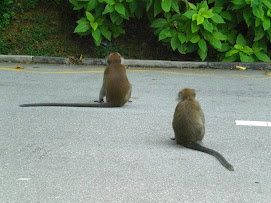
Every so often in Asia, I am struck by the reality of how surreal my life can be. I often feel blessed to have the opportunities I have had, and I often feel awed by the incredible things I have seen. But, only in rare moments am I really forced to pause and reflect on the oddity of my day to day existence. For example, a monkey steals my breakfast, I spend over an hour trying to find a hostel in Phuket after a driver, who we paid to drive us to our hostel, decides not to, and I wake up under a mosquito net in a tree house on a private beach.
One of these rare “you live in unreality” moments occurred during my holiday in Chiang Mai. I suddenly saw myself, as if from above, seated in a quite corner of a little ornate Thai Buddhist temple. I was holding a string connecting me to Stephanie, her mom, a German family, and a little old monk who was chanting a hauntingly beautiful monotonous prayer as he threw holy water on us and prepared to send whatever our hearts so desired to whomever ‘out there’ we wished. Talk about unreality.
When the prayer finished, the monk ceremoniously tied a monk-blessed bracelet on the women’s left wrists and the men’s right while boisterously announcing wishes for good luck in business, love, home ownership, money and relationships. And then it was over, as fast as it had occurred. I was back to navigating a walking tour of Chiang Mai’s temples with Stephanie and Clara, the unreality of the moment before simply a palpable memory.
With over 60 active Buddhist temples and 300 temple ruins within just the 4x4 km Old City and many more temples in the greater metropolis, it is no wonder monk encounters are common in Chiang Mai. Before sunrise, one can spot monks on every street and alleyway in the city collecting their daily alms. Alms gathering involves carrying a bowl and bag which the monks will present at the door for donors to offer them food in exchange for prayers and blessing. Monks are not allowed to cook for themselves as it is considered an uncleanly task.
Not only will you spot monks in the early waking hours, however, as many spend their time in the temple complexes eagerly waiting for the chance to practice their English with tourists. We had a lovely conversation with a 25-year-old monk who had been living at Wat Phra Singh as first a novice and then a monk for 10 years of his short life. He has hopes of leaving his life as a monk behind to start a family and teach Thai children English when he turns 30. In the hour-long conversation, we discussed everything from the requirements of being a monk to the sects of Buddhism to famous American boxers. As it turned out our monk friend was a huge fan of Muay Thai or Thai Boxing and could rattle off the names of tens of famous boxers, the only of which I recognized were Muhammad Ali and George Foreman (but mostly because of the grill).
Monks also wait in the temples to offer their insight into the histories of the buildings and traditions of Buddhism. In some of the smaller complexes they offer prayers and blessings complete with the aforementioned blessed-string tying ceremony.
In addition to exploring the infinite temples, which naturally included these monk encounters, Stephanie, Clara and I took a Thai cooking class indulging in classic Thai dishes like green curry, papaya salad, pad Thai, spring rolls, and mango sticky rice. We wandered through the street markets and pampered ourselves with classic Thai massages. We donned harnesses and flew like gibbons on 15 zip lines in the tree-top canopy before hiking to the top of a breathtaking waterfall. We went elephant trekking to a hill tribe village, climbed the steps to a mountain temple, and took a dinner cruise on the Ping river, once again enjoying all the local flavor Thailand has to offer.
The natural and man-made beauty, the incredible food, the ever-smiling people, and the memorable adventures with wonderful company made my weekend in Chiang Mai one which I will always hold dear. And as I look back, the vivid memories seem to fittingly turn a lovely shade of fading orange.
Everywhere in and around Chiang Mai the monks can be seen wearing their golden saffron colored robes in emulation of Buddha’s humble garb and to represent their own detachment from the physical world in pursuit of enlightenment. Yet the presence of the robes themselves seems very much an attached and necessary element in the creation, maintenance, and pure existence of the physical world that is Chiang Mai. The orange-red of the monk’s robes ebbs and flows with the bustling traffic and movement of people, it interlaces itself into the daily life of Thai’s and tourists alike, it twirls and spins into every corner of the city until it becomes indistinguishable from the city itself, it weaves colorful, intricate designs into the passage of time here, and it shades and coats my memories. And what a lovely city Chiang Mai is because of it.
xoxo,
Rachel
One of these rare “you live in unreality” moments occurred during my holiday in Chiang Mai. I suddenly saw myself, as if from above, seated in a quite corner of a little ornate Thai Buddhist temple. I was holding a string connecting me to Stephanie, her mom, a German family, and a little old monk who was chanting a hauntingly beautiful monotonous prayer as he threw holy water on us and prepared to send whatever our hearts so desired to whomever ‘out there’ we wished. Talk about unreality.
When the prayer finished, the monk ceremoniously tied a monk-blessed bracelet on the women’s left wrists and the men’s right while boisterously announcing wishes for good luck in business, love, home ownership, money and relationships. And then it was over, as fast as it had occurred. I was back to navigating a walking tour of Chiang Mai’s temples with Stephanie and Clara, the unreality of the moment before simply a palpable memory.
With over 60 active Buddhist temples and 300 temple ruins within just the 4x4 km Old City and many more temples in the greater metropolis, it is no wonder monk encounters are common in Chiang Mai. Before sunrise, one can spot monks on every street and alleyway in the city collecting their daily alms. Alms gathering involves carrying a bowl and bag which the monks will present at the door for donors to offer them food in exchange for prayers and blessing. Monks are not allowed to cook for themselves as it is considered an uncleanly task.
Not only will you spot monks in the early waking hours, however, as many spend their time in the temple complexes eagerly waiting for the chance to practice their English with tourists. We had a lovely conversation with a 25-year-old monk who had been living at Wat Phra Singh as first a novice and then a monk for 10 years of his short life. He has hopes of leaving his life as a monk behind to start a family and teach Thai children English when he turns 30. In the hour-long conversation, we discussed everything from the requirements of being a monk to the sects of Buddhism to famous American boxers. As it turned out our monk friend was a huge fan of Muay Thai or Thai Boxing and could rattle off the names of tens of famous boxers, the only of which I recognized were Muhammad Ali and George Foreman (but mostly because of the grill).
Monks also wait in the temples to offer their insight into the histories of the buildings and traditions of Buddhism. In some of the smaller complexes they offer prayers and blessings complete with the aforementioned blessed-string tying ceremony.
In addition to exploring the infinite temples, which naturally included these monk encounters, Stephanie, Clara and I took a Thai cooking class indulging in classic Thai dishes like green curry, papaya salad, pad Thai, spring rolls, and mango sticky rice. We wandered through the street markets and pampered ourselves with classic Thai massages. We donned harnesses and flew like gibbons on 15 zip lines in the tree-top canopy before hiking to the top of a breathtaking waterfall. We went elephant trekking to a hill tribe village, climbed the steps to a mountain temple, and took a dinner cruise on the Ping river, once again enjoying all the local flavor Thailand has to offer.
The natural and man-made beauty, the incredible food, the ever-smiling people, and the memorable adventures with wonderful company made my weekend in Chiang Mai one which I will always hold dear. And as I look back, the vivid memories seem to fittingly turn a lovely shade of fading orange.
Everywhere in and around Chiang Mai the monks can be seen wearing their golden saffron colored robes in emulation of Buddha’s humble garb and to represent their own detachment from the physical world in pursuit of enlightenment. Yet the presence of the robes themselves seems very much an attached and necessary element in the creation, maintenance, and pure existence of the physical world that is Chiang Mai. The orange-red of the monk’s robes ebbs and flows with the bustling traffic and movement of people, it interlaces itself into the daily life of Thai’s and tourists alike, it twirls and spins into every corner of the city until it becomes indistinguishable from the city itself, it weaves colorful, intricate designs into the passage of time here, and it shades and coats my memories. And what a lovely city Chiang Mai is because of it.
xoxo,
Rachel
Monday, August 16, 2010
Hill tribe ballerinas
Many of the most famous ballets ever created feature the ballerina in an other-worldly role. She is the queen of the fairly-tale sweet land in the Nutcracker, she is the hauntingly beautiful ghost in Giselle, she is both the gentle white and the malevolent black swans in Swan Lake, she is the precious, untouchable princess in Sleeping Beauty and the list goes on. It is no wonder, then, that there is an almost ethereal quality for which every ballerina strives: her long, thin, powerful legs carrying her through quick, intricate allegro sequences that leave her hovering angelically above the stage; her beautiful arches supporting her in multiple turns en pointe; her slender arms placed in precise positions so that she looks at once demurely feminine and strangely powerful and influential; and that incredible neck-line which allows the body to seem, if possible, even longer, closer to heaven.
For much of my life, I have yearned to create the ballerinas’ perfect, long arabesque line in studios from South Dakota to Singapore. I have coveted the professional primas’ incredible turn-out and their elongated musculature at they danced across stages from London to Minneapolis. I have longed for that enviable juxtaposition of powerful femininity in my own performing pursuits from Asia to Wyoming. I am no stranger to this powerful desire burning inside my core when I am myself dancing, enveloped in the familiarity of a ballet studio, and when I am watching the magical, enchanting world of a romantic-era ballet unfold on a grand stage. It is a common desire lit by a common set of circumstances: the smooth wooden floor, the smell of worn leather, the velvety leotards.
Imagine my surprise, then, when this proverbial desire’s flame was ignited, not by the familiar triggers in some ballet studio or in the plush seats of a theatre, but rather in a secluded hill tribe village in northern Thailand.
Over the National Day holiday, I traveled with Stephanie and her mom, Clara, to Chiang Mai. Located among the highest mountains in the country, the largest city in northern Thailand serves as not only a cultural center but also as the access point to incredible jungle excursions and visits to local hill tribes.
While there, we were able to visit one of the refugee villages in the area which serves as a home to several sub-groups of the Karen people, a Tibeto-Burman ethnic minority. One of the sub-groups, the Kayan or Padaung, fled to northern Thailand in the late 1980s and early 1990s due to conflict with the military regime in Burma. And in northern Thailand they remain, living with uncertain legal status, limited access to medical care, and only enough land to produce food for themselves. While the men work during the day, the women remain in the village, selling their wares for tourists’ dollars. Yet, despite the hardships they have faced (which as a disclaimer, I can in no way relate to), there does not seem to be sadness in their eyes. The women smile, chatting and laughing as they weave their beautiful threads into intricate fabrics, the children play a game like jacks with the smooth stones they have polished when they are not attending school taught by volunteers in their one-room school house, and the babies laze happily in cotton hammocks in the shade provided by the wooden houses. They are the most beautiful people I have ever seen.
And, it was in this village that I found myself once again longing for that swan-like neck of a beautiful ballerina. You see, this was not the first time I had laid eyes on the Kayan people. Though never in person, I had often seen photographs of these beautiful women with their impossibly long neck lines and incredibly poised demeanor in my dance history classes in college. The Kayan people are well-known for that graceful neck-line for which we so often strive in ballet.
We are shown pictures of the Kayan people in dance history classes to emphasize the fact that throughout history and in many places around the world, people have found and still find the long neck line to be an aesthetically pleasing quality. And, in fact, as ballet developed, it also developed a focus on the beauty of an elongated neck in the same way the Kayan appreciate long necks.
In ballet, we are trained to hold the neck upright and the pull the scapula and shoulders down in an attempt to create the ethereal quality necessary for the perfect line. Often, though, genetics also play a major role in giving a ballerina her desirable elongated limbs. The Kayan people, however, take matters into their own hands in order to create the visually pleasing neck-line.
From a young age the Kayan Lahwi women wear coils of brass around their necks, an ornament the women associate with cultural identity and beauty. As they grow older, the coils, which are wrapped around their necks during a process in which the brass is heated to make it more malleable, become longer. Over time, the weight of the brass pushes the collarbone down and compresses the rib cage creating the illusion of a stretched neck. The women rarely remove the rings as both coiling and uncoiling are lengthy procedures, and after a long period of wear, the rings become in integral part of the body. While a long neck line helps to earn ballerinas the leading roles, the Kayan women’s neck length determines their dowry.
Ideas regarding the reason the women wear the coils range from increasing attractiveness (it exaggerates sexual dimorphism as women naturally have longer necks than men) to creating a closer resemblance to a dragon, an important creature in Kayan folklore. Many Kayan women, though, simply view the rings as a part of their ethnic costume.
Among these beautiful women in their own hill tribe village, I was reminded that the beauty and grace associated with a long neck can be translated across cultures and across times. And what a wonderful experience to see in person the women whom I have often admired in the same way I admire Giselle, Sleeping Beauty, and the Sugar Plum Fairy.
xoxo,
Rachel
For much of my life, I have yearned to create the ballerinas’ perfect, long arabesque line in studios from South Dakota to Singapore. I have coveted the professional primas’ incredible turn-out and their elongated musculature at they danced across stages from London to Minneapolis. I have longed for that enviable juxtaposition of powerful femininity in my own performing pursuits from Asia to Wyoming. I am no stranger to this powerful desire burning inside my core when I am myself dancing, enveloped in the familiarity of a ballet studio, and when I am watching the magical, enchanting world of a romantic-era ballet unfold on a grand stage. It is a common desire lit by a common set of circumstances: the smooth wooden floor, the smell of worn leather, the velvety leotards.
Imagine my surprise, then, when this proverbial desire’s flame was ignited, not by the familiar triggers in some ballet studio or in the plush seats of a theatre, but rather in a secluded hill tribe village in northern Thailand.
Over the National Day holiday, I traveled with Stephanie and her mom, Clara, to Chiang Mai. Located among the highest mountains in the country, the largest city in northern Thailand serves as not only a cultural center but also as the access point to incredible jungle excursions and visits to local hill tribes.
While there, we were able to visit one of the refugee villages in the area which serves as a home to several sub-groups of the Karen people, a Tibeto-Burman ethnic minority. One of the sub-groups, the Kayan or Padaung, fled to northern Thailand in the late 1980s and early 1990s due to conflict with the military regime in Burma. And in northern Thailand they remain, living with uncertain legal status, limited access to medical care, and only enough land to produce food for themselves. While the men work during the day, the women remain in the village, selling their wares for tourists’ dollars. Yet, despite the hardships they have faced (which as a disclaimer, I can in no way relate to), there does not seem to be sadness in their eyes. The women smile, chatting and laughing as they weave their beautiful threads into intricate fabrics, the children play a game like jacks with the smooth stones they have polished when they are not attending school taught by volunteers in their one-room school house, and the babies laze happily in cotton hammocks in the shade provided by the wooden houses. They are the most beautiful people I have ever seen.
And, it was in this village that I found myself once again longing for that swan-like neck of a beautiful ballerina. You see, this was not the first time I had laid eyes on the Kayan people. Though never in person, I had often seen photographs of these beautiful women with their impossibly long neck lines and incredibly poised demeanor in my dance history classes in college. The Kayan people are well-known for that graceful neck-line for which we so often strive in ballet.
We are shown pictures of the Kayan people in dance history classes to emphasize the fact that throughout history and in many places around the world, people have found and still find the long neck line to be an aesthetically pleasing quality. And, in fact, as ballet developed, it also developed a focus on the beauty of an elongated neck in the same way the Kayan appreciate long necks.
In ballet, we are trained to hold the neck upright and the pull the scapula and shoulders down in an attempt to create the ethereal quality necessary for the perfect line. Often, though, genetics also play a major role in giving a ballerina her desirable elongated limbs. The Kayan people, however, take matters into their own hands in order to create the visually pleasing neck-line.
From a young age the Kayan Lahwi women wear coils of brass around their necks, an ornament the women associate with cultural identity and beauty. As they grow older, the coils, which are wrapped around their necks during a process in which the brass is heated to make it more malleable, become longer. Over time, the weight of the brass pushes the collarbone down and compresses the rib cage creating the illusion of a stretched neck. The women rarely remove the rings as both coiling and uncoiling are lengthy procedures, and after a long period of wear, the rings become in integral part of the body. While a long neck line helps to earn ballerinas the leading roles, the Kayan women’s neck length determines their dowry.
Ideas regarding the reason the women wear the coils range from increasing attractiveness (it exaggerates sexual dimorphism as women naturally have longer necks than men) to creating a closer resemblance to a dragon, an important creature in Kayan folklore. Many Kayan women, though, simply view the rings as a part of their ethnic costume.
Among these beautiful women in their own hill tribe village, I was reminded that the beauty and grace associated with a long neck can be translated across cultures and across times. And what a wonderful experience to see in person the women whom I have often admired in the same way I admire Giselle, Sleeping Beauty, and the Sugar Plum Fairy.
xoxo,
Rachel
Sunday, August 15, 2010
Living dreams, blazing trails, and celebrating in style
August is a month for mile-stone celebrations in Singapore. My own one-year anniversary with this island city-state is fast approaching. On 9 August 2010, Singapore celebrated her 45th birthday under the theme “Live our Dreams, Fly our Flag.” And, Singapore just hosted the opening ceremonies for the inaugural Youth Olympic Games on the evening of August 14.
 After the celebratory parade, I was left feeling a bit sentimental. While I am quite looking forward to coming home to my loved ones, I am also, I have realized as the time draws nearer, going to miss the people, weather, exotic vacation destinations, food, and cultural exposure which Singapore has so willingly provided.
 Singapore separated from Malaysia in 1965 after being occupied by both Britain and, briefly, Japan during the Second World War. Every year since 1966 they have paraded through their beloved city to commemorate their independence, and every year since the mid-1980’s they have dedicated a special song to the day. One song in particular, from 1998, appealed to me not only for the warm memories of Singapore it carried in its cords, but also for the underlying beats reminding me of my South Dakota Home.


 So here’s to living dreams, blazing trails, and celebrating in Singapore in style this month.
I have been lucky enough to take part in all of the events in one way or another. I will, of course, play the biggest part in my anniversary celebration with Singapore on 24 August…more likely than not with my friends sushi, sake rice wine, and, a new discovery from the brilliant minds of Singapore’s own Island Creamery which also serves Tiger Beer-flavored ice cream, pear sake-flavored ice cream.
While I was unable to attend the annual National Day Parade, which I understand was quite the spectacle displaying, in true patriotic fashion, marching uniformed groups, tanks, helicopters swinging giant red and white flags above the city, and an impressive fireworks show, I did witness my school’s National Day celebration. Not only was I impressed with and touched by my students’ enthusiasm for their country’s birthday, but also I realized what a unique experience it was for a person coming from a country which celebrates its Independence Day over the summer holidays to simply see such a celebration in a school.
After the celebratory parade, I was left feeling a bit sentimental. While I am quite looking forward to coming home to my loved ones, I am also, I have realized as the time draws nearer, going to miss the people, weather, exotic vacation destinations, food, and cultural exposure which Singapore has so willingly provided.Singapore separated from Malaysia in 1965 after being occupied by both Britain and, briefly, Japan during the Second World War. Every year since 1966 they have paraded through their beloved city to commemorate their independence, and every year since the mid-1980’s they have dedicated a special song to the day. One song in particular, from 1998, appealed to me not only for the warm memories of Singapore it carried in its cords, but also for the underlying beats reminding me of my South Dakota Home.This is Home truly
Where I know I must be
Where my dreams wait for me
Where the river always flows
This is Home surely
As my senses tell me
This is where I won’t be alone
For this is where I know; it’s Home
Where I know I must be
Where my dreams wait for me
Where the river always flows
This is Home surely
As my senses tell me
This is where I won’t be alone
For this is where I know; it’s Home
In addition to taking part in the nation’s birthday celebrations, I also accompanied my students to watch the first ever Youth Olympic torch as it ‘Blazed the Trail’ by my school carried by one of Commonwealth’s own. That same evening, I went with some 40 Commonwealthians to two girl’s preliminary soccer matches. We saw Turkey beat Iran 3-2 and Chile win in the last seconds against Trinidad and Tobago 1-0. I am so pleased with the interest in general knowledge and the world outside of Singapore that the YOG has stirred up in my students and also with the teachable and learnable moments with which both National Day and the YOG have provided to me.
So here’s to living dreams, blazing trails, and celebrating in Singapore in style this month.Cheers,
Rachel
Sunday, August 1, 2010
3-2-1 Action
 Scene: A young American couple lands on a secluded, white-sand beach in Thailand. When hopping over the side of the bum boat, the male cuts his heel on the tip of a rusty nail sticking out the side of the weathered wood. Eager to begin his dive, the man takes no notice and joins the beckoning female in the cool, salty water, thinking the saline will clean the wound. (The camera zooms in on the cut, which has begun to trickle blood and an ominous music starts to fade in.) With no one in sight but the sleeping Thai boat driver, the couple excitedly dons scuba gear and dives in the azure blue water, marveling at the rainbow of sea life they see below. They swim further and further from shore and from the safety of the boat. Suddenly she spots a shark. Within seconds she turns, screaming and flailing wildly as she swims back toward the boat, “SHARK!” With a look of pure, incredulous horror, he says, “I’m bleeding.” End scene.
 What comes next may be far too obvious to fans of the deep blue dramas like Open Water or Jaws. However, before you jump to conclusions, you should know that this scene has further stage instructions and a surprise ending.
Tim and I have been cast in the lead roles. The scene is set on Koh Phi Phi Lee Island in Thailand on July 5, 2010. And, probably most importantly, the shark is about the size of a large bass and, on a previous trip, a former boat driver may have mentioned that any small sharks we see in the area are harmless. However, the rest of the scene did play out very similarly to the one above, with a bit of writer’s liberty about the details taken for effect. I certainly swam, flailing in a mad panic, back toward Tim screaming, “SHARK!” with all the ferocious, passionate, dramatic fear I could muster. And he was bleeding. And he was quite nervous. And he was a bit mad at me when I finally came to my senses and explained the actual size and probable intention of the shark. But it makes for a good comedy non-the-less.
It seems my life has been one film reel after the next lately and not only because of all the exciting adventurous I have been on.
Mom, Dad, Elizabeth and I spent a day behind the scenes at Universal Studios. We saw Shrek come alive in 3-D, learned how Spielberg achieves his famous special effects, avoided the T-Rex and, for the most part, the water (sorry Mom) on the raft ride, and lived to tell the tale of The Mummy rollercoaster.
 In Cambodia, Mom, Elizabeth and I set foot on the actual set of Lara Croft: Tomb Raider when we visited Ta Prohm Temple (also known as The Angelina Jolie Temple) and others in the Angkor compound. In the movie, Jolie’s character Lara Croft must race against time and villains to recover powerful ancient artifacts, some of which lie below the temples.
In Thailand, very near to the near-death shark attack, Tim and I walked along Maya Beach, the filming location for The Beach staring Leonardo DiCaprio. In the movie, Leo’s character discovers that in paradise, looks can be deceiving. Ironically, the movie actually features a shark attack. Good thing I saw it after our trip, or my reaction to the actually shark may not have been quite as cool and calm.
.JPG) During our weekend trip to Penang, Malaysia, a little old man with four front teeth and a fondness for constant tooth-less chatter peddled Tim and me around to the various historical buildings and locales in Georgetown. Among the famous are homes and buildings featured in the 1999 Jodie Foster film Anna and the King. The film is loosely based on Anna and the King of Siam and the musical The King and I. One of our toothless, non-stop chattering guide’s favorite silence-fillers was, “You know Anna and the King. You know Jodie Foster. It filmed here.” After 38 times, we knew. But it was a beautiful tour non-the-less.
During our weekend trip to Penang, Malaysia, a little old man with four front teeth and a fondness for constant tooth-less chatter peddled Tim and me around to the various historical buildings and locales in Georgetown. Among the famous are homes and buildings featured in the 1999 Jodie Foster film Anna and the King. The film is loosely based on Anna and the King of Siam and the musical The King and I. One of our toothless, non-stop chattering guide’s favorite silence-fillers was, “You know Anna and the King. You know Jodie Foster. It filmed here.” After 38 times, we knew. But it was a beautiful tour non-the-less.
So there you have it, eight days, eight entries…and we’re all caught up.
Back to making the movie that is my life.
xoxo,
Rachel
A desire to fly
Ever since ancient times, humans have been obsessed with a desire to fly. The ancient Greeks idolized the mythological heroes Daedalus and his son Icarus, who fled from the angry King Minos employing wings that Daedalus himself had constructed. Henri Giffard, the Parisian inventor who made the first powered and controlled flight in his hydrogen-filled airship, has been immortalized, his name being one of 72 inscribed on the Eiffel Tower. Orville and Wilbur Wright are studied by impressed second graders in elementary school classrooms all over the globe as the inventors of the world’s first airplane.

 I wanted to do it how the birds do -- spread my arms, feel the wind in my hair, smile because the rush of air was forcing my cheeks in an upward-outward direction, and know that I was better than on top of the world. As luck would have it, on our second of two weekend-get-aways, Tim and I were able to do just that.
.JPG)

 So how was it? Everything I could have hoped for and more. Not only did I satisfy my instinctual human craving to fly, I got an abs work-out in too. (see side-bar for parasailing images)
Not to mention, for his services to aviation including the first trans-Pacific flight, the Australian Charles Kingsford Smith was knighted, left his legacy as the name of Sydney’s major airport, and was pictured on the Australian $20 note from 1966 to 1994. As the first woman to fly solo across the Atlantic Ocean, Amelia Earhart gave independent women everywhere a fascinating role model. The race to fly the first man to outer space and subsequently send him to the moon caused the whole world to hold its breath. And, today, a child’s first trip on an airplane is nothing less than monumental -- the feeling of soaring above the clouds for the first time often remembered into adulthood.
I too have not escaped this longing to take to the air. But, recently my yearning to fly went beyond the average desire to sit in 7B, munching peanuts, sipping ginger ale, flipping aimlessly through in-flight magazines and making small talk with whatever strange or lovely character might be posted to 7A. I have, after all, had my share of rubbery airplane food, straight-faced immigration officers, turbulence and delayed flights this year alone. (As an aside, the pictures below demonstrate what happens in a Thai airport when you are running on nothing but caffeine and a high from your weekend in paradise, and your plane gets delayed so long that you won’t arrive home until 4 a.m. The icing on the cake – you have to be up for work at 6 the next day.)
I wanted to do it how the birds do -- spread my arms, feel the wind in my hair, smile because the rush of air was forcing my cheeks in an upward-outward direction, and know that I was better than on top of the world. As luck would have it, on our second of two weekend-get-aways, Tim and I were able to do just that.After a day spent lazing on the beach and in the pool at the Hard Rock Hotel on Penang, an island in Malaysia, Tim and I went parasailing. The first towed parachutes were developed by Pierre-Marcel Lemoigne in 1961, and one of the first mentions of its success is of a Frenchman being pulled behind a tractor the same year. Parasailing is offered as a recreational activity for tourists on beaches all over the world. It involves a harness, a parasail, a tow rope, and, thankfully, a boat rather than a tractor. I’m sure you can figure out the rest.
So how was it? Everything I could have hoped for and more. Not only did I satisfy my instinctual human craving to fly, I got an abs work-out in too. (see side-bar for parasailing images)Seven down…one to go.
xoxo,
Rachel
Subscribe to:
Posts (Atom)